
Properly sintered MIM parts typically reach about 95–98% of theoretical density, leaving roughly 1–5% residual porosity that is mostly fine, closed and rounded — not the interconnected sponge structure of lightly pressed powder metal. When the application needs more, hot isostatic pressing (HIP) takes that same part to near-full density, commonly reported at 99.5–100%, because the closed pore structure allows containerless HIP. What the number means for your part depends on which property you are protecting: room-temperature strength tolerates the residual porosity well, while fatigue-critical and pressure-tight duties are where densification earns its cost.
This page gives the realistic density picture for MIM components — what as-sintered density to expect by alloy family, how porosity behaves, what HIP changes and what it does not, and how to specify density so that supplier numbers are actually comparable.
Typical As-Sintered Density
For common engineering alloys — 316L, 17-4 PH, 400-series stainless and the low-alloy steels — production MIM parts land at about 95–98% of theoretical density after standard sintering, with process control and alloy pushing within that band (see the 316L and 17-4 PH pages for alloy-specific behavior). In absolute terms, fully sintered stainless-type MIM parts commonly measure about 7.6–7.8 g/cm³ — but that figure only means something against the theoretical density of the specific alloy.
One caution that saves real confusion: published density values are not all the same kind of number. Some are relative density (percent of theoretical), some are absolute g/cm³, and measurement methods differ — ISO 22068 points to immersion methods per ISO 3369 or gas pycnometry. When a drawing says "95% minimum," the specification should also say how it will be measured, or the buyer and supplier may be comparing different numbers entirely.
What the Residual Porosity Looks Like
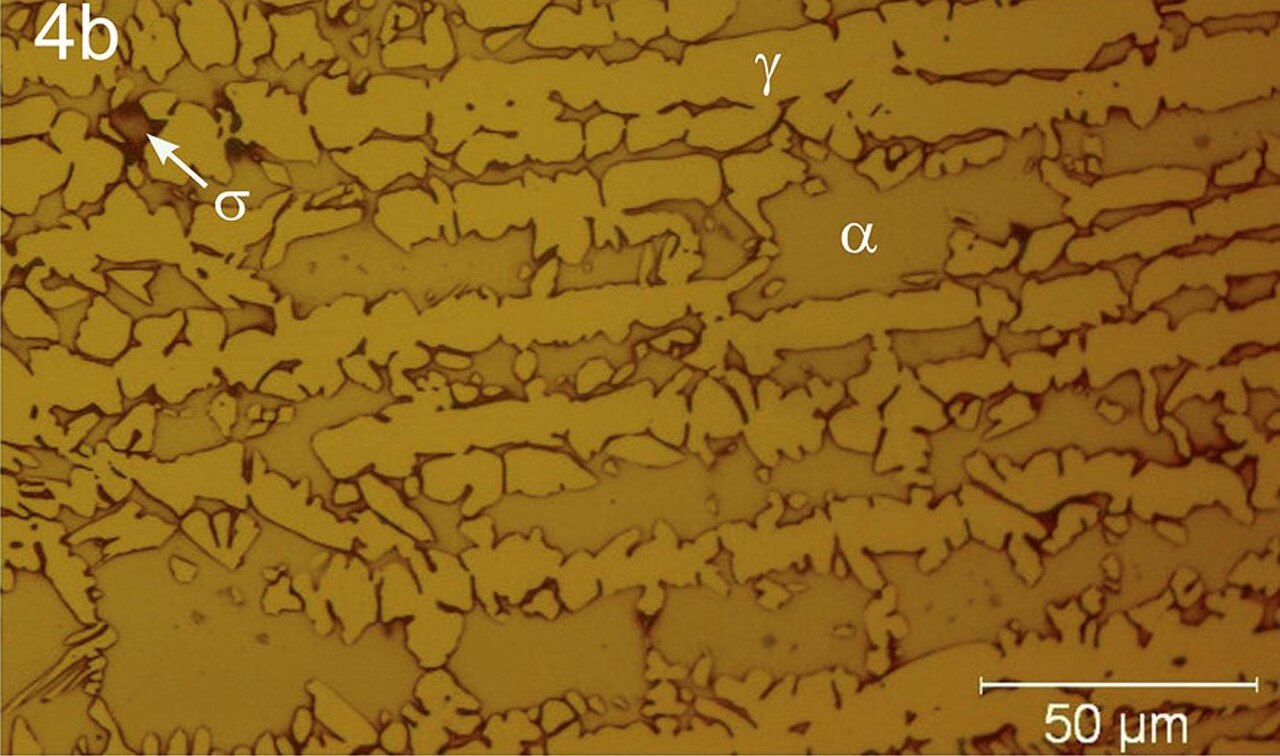
The pore population in well-sintered MIM is characteristically fine, rounded and isolated. That morphology matters more than the headline percentage: rounded closed pores behave like small neutral inclusions, which is why as-sintered MIM retains good ductility and stable tolerances. It is also the reason MIM density above roughly 92–94% enables HIP without any external canister — the pressure medium cannot invade a closed pore structure.
Where porosity does bite is predictably located. Room-temperature tensile behavior is the least sensitive property; fatigue strength and fracture toughness are the most sensitive, because cyclic loading concentrates at pores. One published titanium MIM review reports fatigue strength rising by about 18% when the final roughly 2% of porosity was eliminated by HIP — a clean illustration of where densification pays. Surface-connected porosity can also matter for sealing and plating coverage, which is why fully wetted pressure boundaries usually get a densification or sealing step.
What HIP Changes — and What It Does Not
Hot isostatic pressing applies gas pressure (commonly on the order of 105–140 MPa) at a temperature typically about 100–200 °C below the sintering temperature. For MIM parts with closed porosity, the result is near-full densification — commonly reported at 99.5–100% — collapsing the remaining internal pores. The mechanics of how the process is applied to MIM are covered in the HIP overview.
- Improves most: fatigue strength, fracture toughness, and any property controlled by internal defect population.
- Improves moderately: ductility and impact energy, alloy-dependent.
- Does not replace: alloy selection — HIP densifies the chosen material but adds none of its properties.
- Cost reality: HIP is an added operation; specifying it without a fatigue, toughness or pressure-tight driver is spent money.
Specifying Density Without Ambiguity
| State | Typical density | Typical porosity | Best suited for |
|---|---|---|---|
| As-sintered MIM | ≈95–98% of theoretical | ≈1–5%, fine and closed | General structural, brackets, housings |
| MIM + HIP | ≈99.5–100% | Near zero internal | Fatigue-critical, toughness, pressure-tight |
| Conventional press-and-sinter PM | ≈85–92% (typical structural) | Interconnected, open | Self-lubricating, controlled-permeability parts |
The specification pattern that works in practice: name the state (as-sintered or HIP), the alloy, and the method — for example "316L, as-sintered, ≥95% of theoretical by ISO 3369." Properties then follow the alloy datasheet basis, sintering quality issues surface as their own failure modes (covered in the sintering failure guide), and strength expectations connect to the technical strength analysis rather than to density alone.
Frequently Asked Questions
Q: How dense are MIM parts compared to machined metal?
Machined wrought material is effectively 100% dense; typical as-sintered MIM reaches about 95–98% of theoretical density. The gap is fine, closed porosity that barely affects room-temperature strength but matters for fatigue — and can be closed to near-full density with HIP when the duty justifies it.
Q: Is MIM porosity open or closed?
In properly sintered MIM it is mostly closed and rounded — isolated pores rather than an interconnected network. That is what allows containerless HIP and what distinguishes MIM from conventional press-and-sinter PM, where interconnected porosity is normal and often functional.
Q: When does a MIM part need HIP?
When fatigue strength, fracture toughness, or pressure tightness is a design driver — those are the properties most sensitive to residual porosity. For static structural duty at typical MIM density, HIP is usually an unnecessary cost. The decision belongs in the DFM conversation before the mold is cut.
Q: Does higher density always mean a stronger part?
No — density is one input among alloy choice, sintering quality and heat treatment. Higher density mainly buys fatigue and toughness; room-temperature tensile strength of a well-sintered part already sits close to its wrought-annealed equivalent. Specifying density alone does not guarantee any single property.
Q: Why do suppliers quote different density numbers for the same alloy?
Partly real process differences, partly measurement basis: relative versus absolute density, and immersion versus pycnometry methods give different answers. Normalize to the alloy's theoretical density and tag the measurement method — per ISO 22068 practice — before comparing figures.
Density is a specification decision, not a maxim: the correct number is the lowest one that protects the property your part actually depends on. Send the part requirement — fatigue spectrum, pressure class, or plain structural duty — through the contact page, and the 24-hour quotation will state the density route, alloy basis and measurement method it is priced against.
Precision Metal Parts from Emitech
Nanjing Emitech delivers MIM, CNC machining, and custom metal parts. MIM services · Request a quote