
316L stainless steel is only weakly magnetic. In the fully solution-annealed, fully austenitic condition, fully annealed austenitic stainless steels typically show a relative permeability of about 1.003–1.05 — weak paramagnetism, not zero magnetism — so a magnet is barely attracted or not at all. The exception is cold-worked material: machining, bending, or forming can transform part of the metastable austenite into ferromagnetic strain-induced martensite, and the same 316L part can then show a noticeable pull. Whether a given part reads "magnetic" therefore depends on its composition, thermal history, and how much local deformation it has seen — not on the grade name alone.
This page explains the mechanism behind 316L magnetism, which fabrication steps introduce ferromagnetic phase, what relative permeability to specify when a project has a magnetic limit, and how solution annealing or measurement standards fit into acceptance testing. It closes the loop for MIM parts in 316L, where as-sintered microstructure and any sizing or grinding after the furnace both enter the picture.
Why Austenitic Does Not Mean Nonmagnetic
316L is an austenitic stainless steel: its crystal structure at room temperature is face-centered-cubic austenite, which is paramagnetic — it responds to a magnetic field only very weakly and retains no magnetization. That is the structural reason a 316L part normally shows little or no attraction to a permanent magnet. But "weakly magnetic" is not the same as "nonmagnetic": fully annealed austenitic stainless steels typically have a relative permeability of about 1.003 to 1.05, so a sensitive instrument still measures a response even when a hand magnet does not detect one.
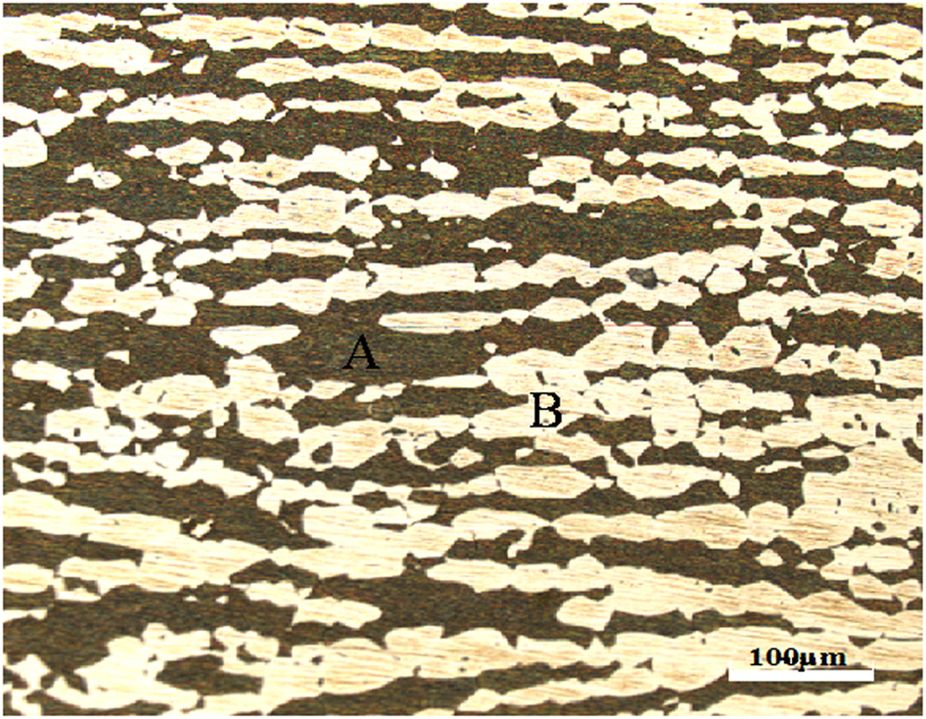
Austenite in the standard 3xx grades is also metastable. Under enough plastic deformation at room temperature, part of the austenite can transform into strain-induced martensite, a body-centered phase that is ferromagnetic. Composition controls how stable the austenite is: nitrogen-bearing grades such as 316LN, and generally more stable austenitic chemistries, retain lower permeability after the same cold work than less stable grades. So two parts both labeled 316L can sit at different points on the magnetic scale purely because their chemistry and processing history differ — relative permeability is not a single material constant for processed 316L.
Residual ferrite is the third contributor. Solidification or welding can leave a small fraction of ferromagnetic ferrite in austenitic products, and a mixed assembly can read magnetic even when the 316L itself is not the culprit. More on the magnetic test trap appears under how to verify, below.
How Cold Work Makes 316L Magnetic
Cold working is the most common reason a 316L part attracts a magnet. Machining, grinding, drawing, bending, rolling, stamping, and thread forming all produce localized cold-worked zones, and a component may therefore be weakly magnetic even when its incoming annealed stock was not. The deformation-driven austenite-to-martensite transformation concentrates exactly where the tool did the most work — cut edges, thread flanks, bend radii, and drawn surfaces — which is why the pull is often patchy rather than uniform across the part.
Magnetic response generally increases with the amount of cold work, but there is no universal permeability-versus-percent-reduction curve for all 316L products: composition and starting microstructure materially affect the result. Deformation temperature matters as well — the transformation is easier near room temperature — so a deep-drawn shell and a lightly machined bar of the same melt can differ sharply. Any quantity stronger than "this much cold work always makes 316L strongly magnetic" should be treated as a red flag rather than a fact.
| Condition | Microstructure | Typical magnetic response |
|---|---|---|
| Fully solution-annealed | Predominantly austenite | Weak paramagnetism; relative permeability typically about 1.003–1.05, commonly ≤1.02 at 200 Oe for 316/316L |
| Locally cold-worked (machined, bent, drawn, threaded) | Austenite plus possible deformation-induced martensite; residual ferrite may contribute | Weak to noticeable attraction, concentrated in deformed zones; no universal μr range — depends on composition, deformation, and test field |
| After full solution anneal (approx. 1050–1120 °C + rapid cool) | Austenite restored; martensite re-dissolved | Returns toward annealed response when the treatment is complete and cooling adequate; verify on the finished part |
| Nitrogen-bearing 316LN or more stable austenitic chemistry | More stable austenite | Generally retains lower permeability after the same cold work than less stable grades |
The practical takeaway from the table: magnetism in 316L is condition-dependent. "316L is nonmagnetic" is defensible for fully annealed, fully austenitic material, but it is not a safe statement for every fabricated or cold-worked part.
What This Means for MIM Parts in 316L
Metal injection molding changes where the magnetic risk sits. The feedstock is injected, debound, and sintered — a thermal route with no cold reduction of the bulk geometry — and the sintered part leaves the furnace in a near-equilibrium, effectively solution-treated condition. In that as-sintered state, a MIM 316L component generally behaves like annealed austenitic material: little or no practical attraction to a permanent magnet. Emitech molds 316L among its stainless MIM families, alongside 304, 17-4PH, 420, and 430L — see the MIM 316L material page for the grade's full property profile.
The cold-work route re-enters through secondary operations. Sizing and grinding after sintering work the surface the same way machining does, so a MIM part that was magnetically quiet out of the furnace can show a local response on sized or ground faces. For a project with a permeability limit, the honest position is: specify the limit, then verify on the finished part after all forming, machining, and grinding steps — not on the raw sintered blank.
One caveat belongs here rather than in a sales pitch: MIM parts sinter to a density of 95–99% of theoretical, and any property claim that depends on exact pore morphology should be validated against the supplier's material data rather than assumed identical to wrought bar. Where a magnetic specification is part of the drawing, treat it as a to-be-verified item in the MIM quality control plan rather than a default.
Removing Magnetism: Solution Annealing
Cold-work-induced magnetism in 316L is reversible. Full solution annealing dissolves or transforms deformation-induced martensite back to austenite; cited treatment ranges are approximately 1050 °C to 1120 °C followed by rapid cooling. The exact schedule depends on the product form and governing specification — it is a controlled thermal treatment with specified temperature, time, atmosphere, and cooling rate, not a generic "heat it and the magnetism disappears" step.
Annealing is not free. It can reduce the cold-work-derived strength of a part — a real trade-off when the part was cold-worked intentionally for strength or dimensional calibration — and it can cause distortion or dimensional movement, which matters for precision components whose tolerances are already committed. Incomplete treatment, inadequate cooling, retained phases, or magnetic material elsewhere in the assembly can leave a measurable response behind, so "annealed" on a traveler is not a substitute for a permeability measurement on the delivered part.
A generic stress-relief treatment below the solution-annealing range should not be assumed to reverse martensite either. If the drawing requires a permeability limit, the specification language should name the condition that must meet it — for example, the part in its final fabricated state, after any required anneal — so supplier and customer test the same object.
How to Verify: From Hand Magnet to ASTM A342
- Hand magnet check: qualitative screening only. Whether a magnet sticks depends on magnet strength, air gap, surface condition, geometry, and the local amount of ferromagnetic phase — a magnet test does not measure permeability and cannot put a number on μr.
- Specification-grade measurement: ASTM A342/A342M covers methods for weakly magnetic materials, including fluxmetric and vibrating-sample methods, applicable to relative permeabilities roughly from 1.0 to 4.0.
- Report the field strength. Weakly ferromagnetic austenitic stainless steels can have field-dependent permeability, so two measurements on the same 316L component can disagree unless the magnetic field strength or field range is reported with the result.
- Ferrite-meter caution: readings calibrated against ferrite standards can estimate ferrite content in suitable materials, but cold-worked 316L may contain martensite; a ferrite-equivalent number should not automatically be read as martensite content.
- Commonly specified limit: type 316 and 316L are commonly specified at approximately μr ≤ 1.02 at a field of 200 Oe in the annealed condition — published limits and test conditions differ, so match the spec to the actual service condition.
For low-magnetic or MRI-adjacent applications, a hand magnet is not sufficient to qualify material: the required limit, the field strength, spatial uniformity, assembly geometry, and the manufacturing condition of the part must each be specified. A part that passes a magnet check can still fail a permeability limit, and a part that attracts a magnet is not automatically the wrong alloy — cold work, weld-related microstructural variation, contamination, or mixed-material construction can all produce attraction without establishing alloy identity.
Specifying 316L When a Magnetic Limit Exists
The cleanest way to keep 316L out of magnetic arguments is to write the condition into the purchase documents. A robust line item names the alloy and condition (solution-annealed), the permeability limit with its field strength (for example in the spirit of μr ≤ 1.02 at 200 Oe, or the limit your industry actually requires), the test method (ASTM A342/A342M or agreed equivalent), and the object to be tested — the finished part, after all forming and machining. Without the condition and the field, two laboratories can honestly report different numbers for the same piece of metal.
Grade selection can lower the risk before testing begins: austenitic grades with greater austenite stability, including nitrogen-bearing 316LN, generally retain lower permeability after cold work. If a design cannot avoid heavy cold work and still needs a tight permeability ceiling, a stability-enhanced grade or a post-forming anneal belongs in the plan from the start — retrofitting magnetism out of a finished assembly is always more expensive than specifying it correctly. The trade-offs between 316 and 316L are covered in 316 vs 316L, and for functional magnetic materials the opposite problem — choosing a soft-magnetic alloy on purpose — is handled in MIM magnetic properties.
Frequently Asked Questions
Q: Is 316L stainless steel magnetic in the annealed condition?
Only weakly. Fully annealed austenitic stainless steels typically show a relative permeability of about 1.003–1.05, and 316/316L is commonly specified at approximately μr ≤ 1.02 at a field of 200 Oe. A hand magnet usually detects little or no attraction, but that is weak paramagnetism, not zero magnetism.
Q: Why does my 316L part attract a magnet after machining or bending?
Cold work can transform part of the metastable austenite into ferromagnetic strain-induced martensite. Machining, grinding, drawing, bending, rolling, stamping, and thread forming all create localized cold-worked zones, so the part can be weakly magnetic even when the incoming annealed stock was not. The response is usually strongest at edges, flanks, and bend radii.
Q: Can solution annealing remove the magnetism from cold-worked 316L?
Yes, when it is a full solution anneal — cited ranges are approximately 1050–1120 °C followed by rapid cooling — which dissolves or transforms the deformation-induced martensite back to austenite. It is not a free step: it can reduce cold-work strength, cause distortion, and shift dimensions, and a generic low-temperature stress relief should not be assumed to reverse martensite.
Q: What relative permeability should be specified for 316L?
Specify the limit together with its test field and the material condition. A widely used reference point for annealed 316/316L is approximately μr ≤ 1.02 at 200 Oe, but published limits and test conditions differ, so align the number with the actual service requirement and cite the method — ASTM A342/A342M — in the purchase documents.
Q: Is a magnet test sufficient to qualify 316L for a low-magnetic application?
No. A hand magnet is a qualitative screen that depends on magnet strength, geometry, and surface condition; it cannot measure permeability. Low-magnetic and MRI-adjacent applications need a numerical limit, a stated field strength, a defined method such as ASTM A342/A342M, and testing on the finished part after all fabrication. Conversely, a magnet sticking does not prove the alloy is wrong — cold work, welding effects, contamination, or mixed construction can all cause attraction.
"Is 316L magnetic?" has a condition-dependent answer: annealed and austenitic, it is only weakly paramagnetic; cold-worked, it can show real ferromagnetic pull from strain-induced martensite; and the fix — a full solution anneal — trades away cold-work strength and risks dimensional movement. If your drawing carries a permeability limit, treat it as a condition-plus-field-plus-method specification and verify it on the finished part. For MIM parts in 316L, Emitech can review the magnetic requirements alongside the normal DFM feedback — send the drawing through the contact page and the team responds with a quotation within 24 hours.
Precision Metal Parts from Emitech
Nanjing Emitech delivers MIM, CNC machining, and custom metal parts. MIM services · Request a quote