
What is the Powder Metallurgy Process?
Powder metallurgy manufactures metal components by compacting metal powders under high pressure (150-700 MPa) and sintering them at 70-90% of their melting point. Unlike casting or forging, the metal never fully melts. This process achieves over 95% material utilization and creates parts ranging from automotive gears to self-lubricating bearings—some of which simply can't be made any other way.
The process breaks down into five main stages: powder production, blending, compaction, sintering, and secondary operations. But here's what most guides won't tell you upfront: decisions you make in stage one will dictate everything that follows. Choose water-atomized powder to save money? You've just committed yourself to a specific sintering atmosphere strategy before you've even pressed a single part.
Understanding the Cascade Effect
PM isn't a single process—it's a system where early choices ripple through every downstream operation. The powder production method determines your compaction strategy, which influences sintering requirements, which ultimately defines your component's properties.
This guide focuses on those interconnections. If you're evaluating PM for production, you need to understand how the pieces fit together.
The Five Stages of Powder Metallurgy
Complete PM manufacturing process from powder to finished component (7:23)
Powder Production—Where Everything Begins
Your starting powder largely predetermines your final component characteristics. Three main production methods exist, each with distinct trade-offs:
Gas Atomizationproduces spherical particles with exceptional flowability and low oxygen content (under 500 ppm). You'll pay more for this powder, but gain automated die-filling capability and simpler sintering atmosphere requirements. This is the go-to for high-precision applications and metal additive manufacturing.
Water Atomizationdelivers irregular particles at lower cost. The irregular shape provides better mechanical interlocking during compaction, which boosts green strength. The catch? High oxygen content (often 2000-5000 ppm), which means you'll need aggressive hydrogen atmospheres during sintering. For conventional PM structural components where cost matters more than powder purity, this trade-off often makes sense.
Electrolytic Depositioncreates spongy, high-purity powders with excellent compressibility. Common for copper, nickel, and specialized iron applications where contamination is unacceptable.

Real example:A typical automotive transmission contains 15-20 PM gears made from water-atomized iron powder. At million-unit volumes, the cost savings justify the additional investment in sintering atmosphere control.
| Production Method | Particle Shape | Oxygen Content | Cost | Typical Application |
|---|---|---|---|---|
| Gas Atomization | Spherical | <500 ppm | High | Aerospace, metal AM |
| Water Atomization | Irregular | 2000-5000 ppm | Low | Automotive, structural parts |
| Electrolytic | Spongy | <100 ppm | Very High | High-purity copper, medical |
| Chemical Reduction | Irregular | Variable | Medium | Iron-based bearings |
The relationship between production method and downstream processing is deterministic. Select water-atomized powder, and you've committed to specific sintering strategies before pressing your first part.
Powder Blending and Mixing
Blending and mixing aren't the same thing.Blendingcombines powders of identical chemistry but different lots for batch uniformity.Mixingcombines different materials to create alloys or introduce processing additives.
Three alloying strategies:
Elemental (mixed) powdersmaintain the base metal's soft, compressible nature. You physically mix iron with graphite, copper, or nickel powders. The risk is segregation—finer particles like graphite can separate during handling, creating composition gradients in your final part.
Pre-alloyed powderseliminate segregation entirely. Every particle contains the correct alloy chemistry because alloying happened in the molten bath before atomization. But these harder particles demand 20-40% higher compaction pressures.
Diffusion-alloyed powderssplit the difference. Alloying elements are partially bonded to base particle surfaces, preventing segregation while maintaining better compressibility than fully pre-alloyed powders.
Lubricants are mandatory.Zinc stearate or similar compounds (typically 0.5-1.0% by weight) reduce inter-particle friction and die-wall friction. Without adequate lubrication, you'll destroy expensive tooling through galling and wear within thousands of cycles. These lubricants must completely volatilize during sintering—any residue during high-temperature bonding contaminates the final part.
The alloy strategy you choose determines your minimum production volume. Pre-alloyed powders cost more than elemental mixes, but eliminate composition variation risk across production runs. For safety components like automotive connecting rods, that's non-negotiable.
Compaction—Converting Powder to Green Compact
The basics:Feed powder into die cavity → Apply 150-700 MPa pressure → Eject green compact
Prepared powder goes into a rigid die cavity. Pressure (150 to 700 MPa, roughly 10 to 45 tons per square inch) deforms particles, increases contact area, and consolidates the mass into a "green compact"—a fragile, pre-sintered part with geometric precision but limited structural integrity.
Green strength derives from mechanical interlocking of deformed particles and binder adhesion, not metallurgical bonding. Think aspirin tablet strength: handleable but brittle (typically 2-10 MPa tensile strength).
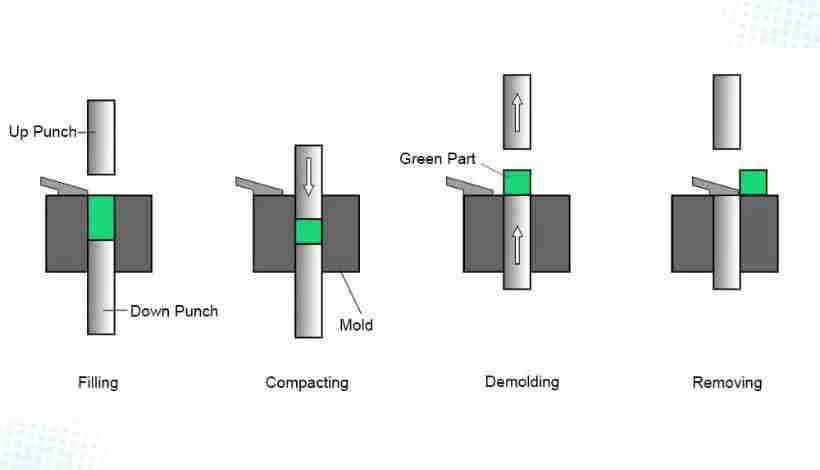
Tooling complexity enables part complexity. Your die assembly consists of the die body, upper and lower punches, and potentially multiple core rods for internal features. Manufacturing this tooling to 0.0002 inch tolerances from hardened tool steels represents significant capital investment—often substantial for complex parts.
Press Selection: Speed vs. Control
| Press Type | Strokes/Min | Force Control | Best For |
|---|---|---|---|
| Mechanical | 30-60 | Fixed | High-volume simple parts (>100K/year) |
| Hydraulic | 5-15 | Fully adjustable | Complex shapes, varied production (<50K/year) |
Mechanical pressesuse flywheel energy and mechanical linkages for high-speed cycling. You'll get 30-60 strokes per minute, ideal for mass production. But force and stroke are fixed—no adjustment for different parts without changing the mechanical setup.
Hydraulic pressessacrifice speed for control. You set precise tonnage and can apply full force at any stroke point. This versatility suits complex geometries, large parts, and smaller production runs, but at 5-15 strokes per minute.
Design limitations stem from physics, not preferences. Powder doesn't flow like liquid. Pressure attenuates with depth due to inter-particle and die-wall friction. This restricts height-to-diameter ratios (typically under 2.5:1 for uniform density), thin walls (minimum 1.5-2mm), and complex contours. Features like undercuts or transverse holes typically require post-sintering machining because they prevent die ejection.
A single-level automotive gear can be pressed at 45 strokes/min on a mechanical press. A three-level planetary carrier with internal features requires a hydraulic press at 8 strokes/min—production speed drops 80%, but the net-shape capability eliminates varies per unit of machining cost per part.
Sintering—The Metallurgical Transformation
Sintering converts your green compact into a coherent component through controlled thermal processing at 70-90% of the metal's absolute melting point. This isn't simple heating—it's a three-phase thermo-chemical process requiring precise atmospheric control.
Phase 1: Delubrication (Burn-off)
Temperature:400-600°C
Duration:20-60 minutes
Atmosphere:N₂ + controlled H₂O
As temperature rises, lubricants volatilize. Your atmosphere must contain controlled moisture levels to react with hydrocarbon lubricants, forming CO and H₂ that flush from the furnace. Without this moisture, lubricants decompose into elemental carbon, contaminating your part. Temperature ramp rates must stay below 5-10°C/min to prevent thermal stress cracking.
Phase 2: High-Temperature Sintering
Temperature:1000-1300°C (for steel)
Duration:15-45 minutes at peak
Atmosphere:Typically 90% N₂ + 10% H₂
Two simultaneous processes occur:
Oxide reduction:Surface oxides block metallurgical bonding. Your hydrogen-containing atmosphere chemically reduces these oxides. Higher oxygen content in your starting powder demands higher hydrogen concentrations—another consequence of your powder selection from stage one.
Solid-state diffusion:With clean metal surfaces in intimate contact at high temperature, atoms migrate across particle boundaries. Predictable microstructural evolution:
- Neck formation at contact points (0-5 min)
- Progressive densification as necks grow (5-20 min)
- Pore rounding and shrinkage (20-35 min)
- Isolated pore formation with grain growth (35+ min)
Phase 3: Controlled Cooling
Rate:10-50°C/min depending on alloy
Atmosphere:Maintained throughout
Cooling must occur within protective atmosphere to prevent re-oxidation. Cooling rates affect final microstructure; rapid cooling can increase hardness but may introduce residual stress.
Temperature and Time: Your Process Levers
| Sintering Temperature | Relative Density | Tensile Strength (Steel) | Typical Application |
|---|---|---|---|
| 1050°C | 85-88% | 300-400 MPa | Low-stress structural parts |
| 1120°C (standard) | 88-92% | 400-550 MPa | Automotive gears, bearings |
| 1250°C | 92-96% | 550-650 MPa | High-performance applications |
| 1350°C + HIP | 99-100% | 700-900 MPa | Aerospace critical components |
Higher sintering temperature or longer hold time increases atomic diffusion, closing more porosity and increasing density. Increasing temperature from 1050°C to 1350°C can raise relative density from 85% to 99% for iron-based alloys. Tensile strength in CoCrMo alloys increases from 400 MPa to 700 MPa across this range.
But excessive temperature causes grain coarsening, potentially degrading mechanical properties. Optimization depends on your specific application requirements.
Aerospace turbine disks require HIP at 1000-1200°C and 100-200 MPa (achieving 100% density for zero-defect tolerance) while automotive transmission gears use conventional sintering at 1120°C (92% density is sufficient, and cost per part drops by 60%).
Secondary Operations
Parts emerge from sintering near-net-shape but may require secondary processing for specific applications.
Dimensional Control
Sizingre-presses the sintered part in a precision die to correct minor dimensional distortions from thermal expansion/contraction. You can improve tolerance limits by 50% through sizing—from typical ±0.3% to ±0.15%.
Coiningre-presses to add features (logos, bevels) or selectively densify specific surfaces for enhanced wear resistance.
Density and Performance Enhancement
Infiltrationfills residual porosity with lower-melting-point metal (typically copper into iron-based parts). Molten copper wicks into the pore network via capillary action, achieving near-full density and dramatically increasing strength (typically +40-60%) and ductility.
Oil impregnationexploits porosity rather than eliminating it. You immerse the part in heated oil, which fills 12-30% of pore volume. This creates self-lubricating bearings where expanding oil migrates to wearing surfaces during operation, then retracts upon cooling.
Resin impregnationseals porosity with polymer, making parts pressure-tight (for hydraulic applications) or improving machinability by supporting the metal matrix during cutting.
Heat treatmentapplies conventional metallurgical processes—quenching, tempering, case hardening—to further enhance mechanical properties.
Steam treatingexposes ferrous parts to high-temperature steam (500-600°C), forming a hard magnetite (Fe₃O₄) surface layer that seals surface porosity and improves wear and corrosion resistance.
| Secondary Operation | Purpose | Cost Increase | When to Use |
|---|---|---|---|
| Sizing | Tighten tolerances | +5-10% | Precision fits required |
| Infiltration | Increase density/strength | +15-25% | High-stress applications |
| Oil Impregnation | Self-lubrication | +8-12% | Bearing applications |
| Steam Treating | Corrosion resistance | +3-5% | Ferrous parts in humid environments |
| Machining | Add complex features | +20-50% | Undercuts, cross-holes, threads |
A self-lubricating bearing requires oil impregnation (+10% cost) but eliminates external lubrication systems (saving varies per unit per assembly in automotive applications). At 500,000 units/year, this secondary operation delivers over variesM annual savings.
Process Variations
Conventional press-and-sinter represents the baseline. Several variants address specific limitations:
Comparative Overview of PM Technologies
| Technology | Part Size | Geometric Complexity | Final Density | Production Rate | Cost/Part |
|---|---|---|---|---|---|
| Conventional PM | 5-5000g | Medium | 85-95% | High (30-60/min) | varies |
| MIM | 0.1-100g | Very High | 96-99% | Medium (5-15/min) | varies |
| HIP | 0.1-500kg | Low-Medium | 100% | Very Low (hours) | varies+ |
| CIP | 1-1000kg | Low | 75-85% | Low | varies |
| Metal AM | 1-5000g | Highest | 99%+ | Very Low (hours) | varies+ |
Metal Injection Molding (MIM)combines fine metal powder (60%) with polymer binder (40%) to create injectable feedstock. You injection-mold complex geometries impossible with conventional PM, then debind (removing binder through thermal and solvent processes over 12-48 hours) and sinter to 96-99% theoretical density. MIM dominates small, complex components in medical, dental, and electronics industries.
Orthodontic brackets require complex undercuts and 3D features. Conventional PM cannot form these shapes. MIM's 3D molding capability captures 80% of the variesM global orthodontic bracket market despite 3-4x higher per-part cost.
Hot Isostatic Pressing (HIP)applies uniform pressure from all directions using inert gas at temperatures of 1000-1200°C and pressures up to 200 MPa. HIP is the only PM process achieving 100% theoretical density, completely eliminating porosity. Used for critical aerospace components (turbine disks) where any internal defect risks catastrophic failure.
Cold Isostatic Pressing (CIP)uses room-temperature fluid pressure to compact powder in flexible molds. This suits large, simple shapes exceeding conventional press capacity (parts up to 1m+ diameter).
Metal Additive Manufacturing (AM)builds parts layer-by-layer directly from digital files using selective laser melting or electron beam melting. While slow (hours per part vs. seconds), AM enables geometries impossible with any other process: internal cooling channels, honeycomb structures, topology-optimized designs.
When PM Makes Sense (and When It Doesn't)
PM works well for:
- Production volumes exceeding 10,000-50,000 parts annually (amortizing tooling costs)
- Part geometry suited to axial pressing (no severe undercuts)
- Applications where material utilization matters (minimize waste to under 5%)
- Tight tolerances required (±0.1-0.3% achievable as-sintered)
- Controlled porosity beneficial (bearings, filters, dampening)
- Material combinations impossible by melting (cermets, immiscible alloys)
- Net-shape features that reduce assembly (gears with integrated hubs)
PM presents challenges for:
- Low-volume production (under 10,000 parts - tooling cost prohibitive)
- Very large parts (over 50 sq. in. projected area - press tonnage limiting)
- Maximum strength/ductility required without secondary operations
- Complex 3D geometries with severe undercuts (consider MIM)
- Rapid prototyping or design iteration (tooling lead times 8-16 weeks)
- Pressure-tight applications without resin impregnation
Industry Applications
Automotiverepresents 70% of PM consumption globally. PM components include:
- Transmission gears and planetary carriers (2-8 parts per transmission)
- Engine connecting rods (performance applications)
- Valve guides and valve seat inserts (every engine)
- VVT (variable valve timing) components
- Shock absorber pistons and components
A single automatic transmission contains 15-25 PM components. At 80 million vehicles/year globally, this represents 1.2-2.0 billion PM parts annually. The combination of mass-production volumes, cost sensitivity (varies per unit/part), weight reduction requirements, and ±0.15% tolerance needs aligns perfectly with PM's strengths.
Self-lubricating bearingsexist solely because of PM. The controlled pore network storing oil cannot be created by any other manufacturing method. Applications span automotive engines, appliances, HVAC systems, and power tools. Global market: around variesB annually.
Sintered filtersfor hydraulic, pneumatic, and chemical systems leverage precise pore size control (5-100 microns) achievable only through PM. You control filtration rating by selecting powder particle size distribution and sintering parameters.
Medical devicesutilize MIM for surgical instruments, orthodontic brackets, and implantable components where small size (under 5g), complex geometry (undercuts, thin walls under 0.5mm), and biocompatibility (316L stainless, Ti-6Al-4V) intersect.
Aerospaceemploys HIP for superalloy turbine components requiring full density and extreme temperature capability (over 1000°C service temperature). A single turbofan engine contains 5-15 HIP'd powder metallurgy disks, each costing varies
Cutting toolsdepend entirely on PM. Tungsten carbide-cobalt cermet inserts—the foundation of modern machining—cannot be produced by melting due to the massive difference in melting points (tungsten carbide: 2870°C; cobalt: 1495°C). Global cutting tool market enabled by PM: over variesB annually.
Understanding Trade-offs
Every decision in powder metallurgy creates downstream consequences:
- Select water-atomized powder→ Accept high oxygen content → Require aggressive atmosphere (20-50% vs. 5-10% H₂) → Increase sintering cost by 15-25%
- Choose mechanical press→ Gain production speed (50 vs. 10 parts/min) → Lose geometric flexibility → Limited to single-level or simple multi-level parts
- Pursue maximum density through HIP→ Achieve 100% density → Multiply processing time (6-8 hours vs. 30 minutes) → Increase part cost by 300-800%
- Use pre-alloyed powder→ Eliminate segregation risk → Require 30% higher compaction pressure → Increase press tonnage requirement and tooling wear
Successful PM implementation requires understanding these cascading trade-offs before committing to tooling investment.
Frequently Asked Questions
Q: What is the difference between sintering and melting in powder metallurgy?
A: Sintering heats metal powder to 70-90% of its melting point (e.g., 1120°C for iron vs. 1538°C melting point), causing atomic diffusion and bonding without liquefaction. Melting exceeds the melting point, creating liquid metal. Sintering allows you to combine materials with vastly different melting points (like tungsten carbide at 2870°C and cobalt at 1495°C) that cannot be melted together without destroying one component.
Q: Why do PM parts have lower strength than forged parts?
A: Conventional PM parts retain 5-15% residual porosity after sintering, reducing load-bearing cross-section. A forged part is 100% dense. A conventionally sintered steel part at 92% density achieves around 450 MPa tensile strength, while the same steel forged reaches around 650 MPa. Secondary operations like copper infiltration can increase PM part strength to around 600 MPa, or HIP can eliminate all porosity, matching or exceeding forged properties.
Q: How much does PM tooling cost and what volume justifies it?
A: Compaction tooling ranges from varies by tooling for simple single-level parts to varies+ for complex multi-level geometries requiring multiple punches and core rods. A typical automotive gear die set costs varies manufactured to 0.0002" tolerances from hardened tool steels with expected life of 500,000-2,000,000 cycles. PM becomes economical only at volumes exceeding 10,000-50,000 parts annually, where tooling cost amortizes to varies per unit per part.
Q: Can you make large parts with powder metallurgy?
A: Conventional PM is limited by press tonnage, typically restricting parts to under 50 square inches projected area and 35 lbs weight. The largest conventional PM presses (around 4000 tons) can produce parts up to roughly 100 sq. in. For larger components, Cold Isostatic Pressing (CIP) can compact parts up to several feet in dimension and over 500 kg weight, though with reduced geometric complexity compared to conventional PM.
Q: What sintering atmosphere is required and why does powder selection affect it?
A: Most sintering uses nitrogen-hydrogen blends — a common composition for steel is 90% N₂ + 10% H₂. Nitrogen provides inert coverage preventing oxidation; hydrogen acts as reducing agent, chemically removing surface oxides (FeO + H₂ → Fe + H₂O) that block metallurgical bonding. Powder selection directly determines hydrogen requirement: water-atomized powder (2000-5000 ppm oxygen) may need 25-50% H₂, while gas-atomized powder (under 500 ppm oxygen) needs only 5-10% H₂ — a direct cost consequence of your stage-one powder decision.
Q: How does powder metallurgy compare to metal additive manufacturing?
A: Both use metal powder but differ fundamentally in economics and geometry. PM compacts and sinters in bulk, achieving 30-60 parts per hour at varies per unit per part for geometries suited to axial pressing. Metal AM (selective laser melting, electron beam melting) builds layer-by-layer at 2-20 hours per part and varies per unit+ per part, but enables internal channels, lattice structures, and topology-optimized geometries impossible with PM. PM dominates mass production above 10,000 units per year; AM is most justified for prototyping, low-volume custom parts under 100 per year, and geometries with conformal cooling channels or extreme complexity.
Q: What is green strength and why does it matter for PM production?
A: Green strength is the mechanical integrity of the compacted powder part before sintering, typically 2-10 MPa tensile strength, derived from mechanical interlocking of deformed particles and binder adhesion rather than metallurgical bonding. Adequate green strength prevents cracking during three critical handling steps: ejection from the die (forces can reach 5-20 tons for large parts), transfer from press to furnace, and loading into sintering trays. Insufficient green strength below 1.5 MPa causes 1-5% scrap rates before any sintering has occurred.
Q: What dimensional tolerances can powder metallurgy achieve?
A: As-sintered parts typically achieve ±0.3% dimensional tolerance on pressed dimensions (e.g., ±0.015mm on a 50mm diameter). Sizing operations improve this to ±0.1-0.15% (±0.005-0.0075mm on 50mm). Perpendicular dimensions parallel to pressing direction are more variable at ±0.5-1.0% due to powder fill variations and density gradients. Surface finish ranges from Ra 1.5-3.0 µm as-sintered, improving to Ra 0.8-1.5 µm after sizing or steam treating — comparable to investment casting but wider than machined tolerances of ±0.01-0.05mm.
Q: Can PM parts be welded or machined after sintering?
A: Machining is possible but conventional PM parts with 8-15% porosity cause accelerated tool wear (20-40% shorter tool life) due to interrupted cutting. Resin impregnation significantly improves machinability. Common post-sintering machining includes drilling, tapping threads, milling flats, and grinding bearing surfaces. For welding, residual porosity acts as stress concentrators and absorbs weld spatter; MIG/TIG welding is preferred over resistance welding. Fully dense PM parts (HIP'd or infiltrated) weld similarly to wrought materials, and brazing is often preferred over welding for joining standard PM components.
Bottom Line
Powder metallurgy isn't a manufacturing shortcut. Component properties result from cascading decisions made throughout the process chain. Understanding this interdependence separates successful PM implementation from costly failures.
The process offers compelling advantages: over 95% material utilization, net-shape capability, controlled porosity for unique functions, and the ability to create materials impossible through melting. But these benefits come with constraints: high tooling investment (varies by tooling), geometric limitations (no severe undercuts), and residual porosity affecting mechanical properties (typically 8-15% lower strength than fully dense materials).
PM becomes cost-effective when production volume exceeds 25,000-50,000 parts annually. Below this threshold, the tooling investment cannot be amortized. A typical automotive transmission gear with varies tooling cost becomes economical at varies per unit higher per-part cost than machining—requiring 150,000 units to break even.
Success with powder metallurgy depends on recognizing it as a system of trade-offs rather than a one-size-fits-all solution. When your application aligns with PM's strengths—high volume, appropriate geometry, tolerance requirements, and material characteristics—few alternative processes deliver comparable cost-effectiveness and precision.
Precision Metal Parts from Emitech
Nanjing Emitech (ISO 9001:2015) delivers MIM, CNC machining, and custom metal parts. MIM services · Request a quote
Last updated: 2026-06-24
Continue reading
- MIM Metal Parts Strength: Why Sintered Components Match CNC Machined Performance
- MIM Parts Benefits: 60-80% Cost Savings vs CNC Machining | ROI Data
- How Long Does It Take to Produce Custom MIM Parts? A Technical Timeline Breakdown
- Why 95% of MIM Parts Fail Without Proper Sintering: A Technical Deep Dive into Sintering Machines