

The powder metallurgy process is a chain, and every link decides what the next one can achieve. Published practice describes five stages — powder manufacture and characterization, blending, die compaction, sintering, and secondary operations — and no single stage can compensate for a deficiency introduced earlier. A powder that packs poorly limits green density no matter how long it is sintered; a compact with a density gradient cannot be rescued by a tighter furnace schedule.
What follows walks the chain in order and states, at each stage, what the process actually controls and where its limits are. It also flags the claims that sound right and are wrong — several of the most common powder-metallurgy selling points do not survive inspection.
Stage 1: Powder Manufacture and Characterization
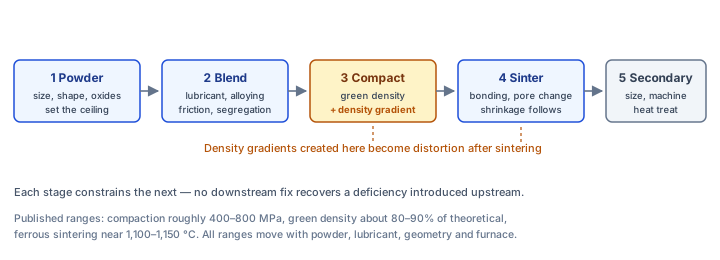
Everything downstream is bounded by the powder. Particle size distribution sets how the particles pack and how quickly they sinter; particle shape sets flowability and compressibility; surface oxides set what the atmosphere must later remove. None of those descriptors alone predicts production performance, which is why powder lots are characterized on several axes rather than one.
The practical consequence is that a change of powder supplier or lot is a process change, not a purchasing detail. Two powders that meet the same nominal chemistry can pack differently, flow differently and sinter to a different density in the same die at the same pressure.
Powder is also where a lot of the process waste lives. Handling losses, screening rejects and out-of-spec fractions occur before anything is compacted — which is the first reason the claim that powder metallurgy produces zero waste does not hold.
Stage 2: Blending and Lubrication
Blending combines elemental or prealloyed powders with lubricant and, where the alloy requires it, additional alloying elements. The lubricant is often treated as a minor ingredient; it is not. It controls die-wall friction and ejection force, and it therefore influences how evenly density develops through the compact. It also determines how much debinding the furnace stage has to do.
Too little lubricant and ejection forces rise, with scoring and cracking risk; too much and green density falls because lubricant occupies volume that would otherwise be metal. That trade-off, not a fixed recipe, is what blending is balancing.
Blending is also where segregation can enter. Fine and coarse fractions separate if handling is rough, and a compact made from a segregated blend sinters non-uniformly — a defect that appears at the end of the chain but originates here.
Stage 3: Die Compaction and Green Density
Uniaxial die compaction presses the blend into a green compact. The compact has enough strength to be handled, and substantially less than the sintered material. Typical compaction pressures for many ferrous press-and-sinter parts sit in the range of roughly 400-800 MPa, and green density commonly lands near 80-90% of theoretical density — both figures being ranges that move with powder, lubricant, geometry, target density and tooling.
The word that matters here is gradient. Pressure applied from the punches does not distribute perfectly evenly, especially in parts with a large height-to-thickness ratio or with complex geometry. Density gradients are expected rather than exceptional, and they convert into differential shrinkage during sintering, which converts into distortion. This is why a die design that fills well is worth more than a higher press tonnage.
Two common claims fail at this stage. The first is that compaction pressure determines final density — it influences it strongly, but powder characteristics, lubricant, tooling, ejection and sintering conditions all participate. The second is that higher pressure always improves the part: beyond a point, higher pressure raises tooling loads, ejection force and cracking risk faster than it raises usable density.
Stage 4: Sintering and What It Actually Changes
Sintering heats the compact below the principal constituent's melting point so that particles bond by diffusion. Necks grow between particles, the pore network rounds and begins to shrink, and the part gains strength and dimensional stability. Conventional ferrous sintering commonly runs near 1,100-1,150 °C, with the window set by alloy system, carbon level, powder condition, atmosphere and the properties the part needs.
Two qualifications keep this description honest. First, not all sintering is purely solid-state: liquid-phase and transient liquid-phase routes involve partial melting, and describing sintering as simply heating below the melting point misses them. Second, shrinkage is not uniform. Parts can shrink, grow, distort or change dimension non-uniformly depending on the density gradient left by compaction and on thermal uniformity in the furnace.
| Stage | What it sets | What goes wrong if it is off |
|---|---|---|
| Powder manufacture and characterization | Packing behaviour, flowability, compressibility, sintering response | Lot-to-lot variation in density and dimensions that no downstream fix recovers |
| Blending and lubrication | Die-wall friction, ejection force, green density, furnace debinding load | Scoring and cracking from too little lubricant; low green density from too much; segregation from rough handling |
| Die compaction | Green density and — critically — the density gradient | Differential shrinkage, distortion, and dimensional scatter after sintering |
| Sintering | Bonding, pore morphology, strength, final density | Under- or over-firing, grain growth, distortion, carbon drift |
| Secondary operations | Final tolerance, surface, hardness, sealing | Cost and lead time discovered late; porosity assumed removed when it is not |
Our own press-and-sinter line runs 17 MIM injection machines alongside dedicated compaction equipment, 22 sintering furnaces split between continuous and vacuum designs, and 13 debinding furnaces — the equipment shapes which schedules are practical, but the material still sets the window.
Stage 5: Secondary Operations and the Net-Shape Claim
Secondary operations include sizing, machining, deburring, heat treatment, impregnation, coating and inspection. Their existence is the second reason the "net shape" claim needs qualification: many designs do come off the furnace close to final form, and many others require sizing to hold a dimension or machining to add a feature the die cannot form.
Sizing deserves separate mention because it is where a lot of powder-metallurgy tolerance discussion actually lands. As-pressed and as-sintered tolerances are geometry- and process-dependent; when a drawing calls for precision beyond what the process holds directly, sizing or machining delivers it — at a cost and at a lead-time that should be planned, not discovered.
Secondary operations also do not universally remove porosity. Sizing closes surface porosity locally, impregnation fills it with a sealant, and heat treatment changes the matrix — none of these is the same as eliminating internal pores, and none should be described as if it were.
Where the Process Wins and Where It Does Not
The process is strongest where the part is small-to-medium, produced in volume, and shaped so that a die can form it in one pressing direction with modest density gradients. It is weakest where sections are very thick or highly varied, where tolerances are tight in several axes at once, where the alloy is difficult to sinter, or where volume is too low to justify tooling.
The honest version of the value proposition: powder metallurgy gives near-net shape at volume with material utilization that machining cannot match, and it charges for that in tooling, in density-gradient risk, and in secondary operations that a brochure may not mention. A design review that surfaces those three costs early is worth more than a lower quoted piece price.
Frequently Asked Questions
Q: What are the steps in the powder metallurgy process?
Five: powder manufacture and characterization, blending with lubricant and any alloying additions, die compaction into a green compact, sintering to bond the particles, and secondary operations such as sizing, machining or heat treatment. Each stage constrains what the next can achieve, which is why the sequence matters more than any single step.
Q: Does powder metallurgy produce net-shape parts with no waste?
Not exactly, on both counts. Many designs come off the furnace close to final form, but sizing, machining, deburring or heat treatment are often still required. And while material utilization is high compared with machining, powder handling losses, screening rejects, die scrap and rejected parts all generate waste.
Q: What compaction pressure is used in powder metallurgy?
Many ferrous press-and-sinter parts run in the region of roughly 400-800 MPa, producing green density commonly near 80-90% of theoretical. Both are working ranges rather than specifications: powder characteristics, lubricant, part geometry, tooling and the target density all move the number, and non-ferrous or high-density routes differ.
Q: Why do powder metallurgy parts distort during sintering?
Most often because compaction left a density gradient, and different densities shrink by different amounts during sintering. Thermal non-uniformity across the furnace load makes it worse. The fix usually belongs in die design and fill, not in the sintering schedule — a schedule change can hide the symptom while leaving the gradient in place.
Q: Are powder metallurgy tolerances tighter than machining?
No — the opposite is the general rule. As-pressed and as-sintered tolerances are geometry- and process-dependent and are typically wider than what machining holds directly. Where a drawing needs more precision, sizing or machining is added as a secondary operation, which is a planned cost rather than a property of the base process.
The powder metallurgy process is best understood as a chain of constraints rather than a list of steps. Powder sets the ceiling, blending and compaction decide how evenly the part approaches it, sintering converts that into bonded material, and secondary operations buy back whatever tolerance the chain could not deliver.
Design reviews that ask about density gradients, secondary operations and the specific alloy's sintering window tend to produce better parts than reviews that negotiate piece price alone. For a specific geometry or alloy, the achievable density and tolerance band are established on a trial compact — part-specific figures are quoted on request.
Precision Metal Parts from Emitech
Nanjing Emitech delivers MIM, CNC machining, and custom metal parts. MIM services · Request a quote