
A sintering process is a temperature-and-atmosphere schedule, not a single set point. Published powder-metallurgy practice describes it as a sequence — purge or burn-off, a high-temperature hold, then controlled cooling — whose timing depends on the powder, the lubricant or binder system, the compact geometry and the furnace. Engineers who treat sintering as "one temperature" usually discover the error later, as distortion, carbon drift or scattered density.
This guide walks the stages in the order they happen, states what the physics actually does at each one, and flags the numbers that are safe to quote versus the ones that must be qualified on your own material.
Why Sintering Is a Sequence, Not a Temperature
Solid-state sintering does not switch on at a threshold. As temperature rises, particles that are already in contact begin to bond: contact areas grow, necks form between particles, and the connected pore network rounds and starts to shrink. Each of those steps has its own kinetics, and each is sensitive to a different variable. Neck growth tracks temperature and hold time; pore rounding tracks surface diffusion; densification tracks grain-boundary diffusion. A schedule that satisfies one does not automatically satisfy the others.
That is why production cycles are built in segments with separate holds rather than one long ramp. The first segment has to remove what would otherwise contaminate the atmosphere or block densification — lubricant in conventional press-and-sinter, binder in metal injection molding. The second must reach a temperature high enough for volume diffusion without triggering grain growth or liquid formation. The third controls how the part cools, which sets residual stress and dimensional drift.
A commonly cited engineering heuristic puts sintering at roughly 20% below the principal melting temperature. Treat it as a starting point for discussion, not a specification: alloy design, activated sintering and high-temperature grades all move the working window, and a schedule that works for one powder lot can under-fire or over-fire another.
The Three Stages and What Each One Is For
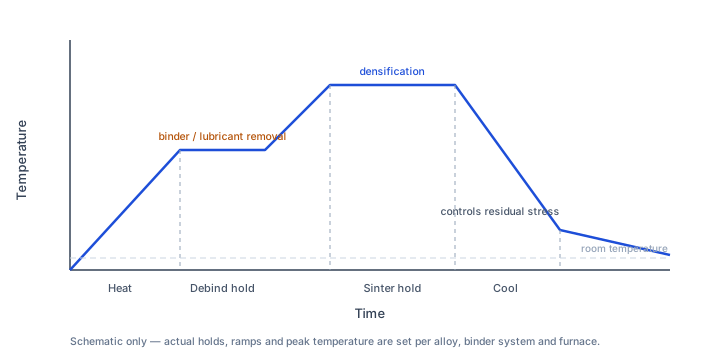
Purge and burn-off. Before the furnace reaches sintering temperature, the load passes through a lower-temperature segment whose job is to remove lubricant or the bulk of the binder. In conventional press-and-sinter this is lubricant burn-off; in MIM it is usually a thermal debinding stage that follows whatever catalytic, solvent or water debinding the process already used. The hold temperature here is formulation-specific, not a universal metal value. Ramp too fast and the decomposition products cannot escape: the result is cracking, blistering or slumping, especially in thin sections.
High-temperature hold. This is where densification actually happens. The part is held long enough for diffusion to close and reshape porosity. Published ferrous practice for conventional press-and-sinter commonly sits near 1,120-1,150 °C, while MIM routinely runs hotter, typically around 1,250-1,400 °C with many standard materials near the top of that band. Both ranges are alloy- and furnace-dependent, and neither transfers directly between the two processes.
Controlled cooling. Cooling is a process variable, not dead time. Cooling rate affects residual stress, dimensional change and — in alloys that transform — the final microstructure. Fast cooling raises the risk of cracking and distortion in large or uneven sections; slow cooling can allow unwanted phase formation or grain growth to continue past the hold.
In MIM the furnace cycle frequently includes the debinding hold and the sinter hold back to back in the same furnace, with total furnace time often under 24 hours. That figure moves substantially with binder system and part size, so it is a planning number rather than a production promise.
Temperature: What the Numbers Do and Do Not Mean
Temperature sets the diffusion rate, and diffusion sets how much porosity closes in the available time. It also sets the risk. Past a certain point, additional temperature buys grain growth and distortion faster than it buys density — and in some alloy systems it can trigger unwanted liquid formation, which destroys dimensional control.
This is why "hotter is better" fails as a rule. Two parts sintered at different temperatures can reach similar density by different routes: the cooler one through a longer hold with finer grain, the hotter one through a shorter hold with coarser grain. Which is preferable depends on whether you need strength, ductility, wear resistance or dimensional stability — and that is an alloy-and-application question, not a furnace question.
A published handbook temperature is also not a production set point. Furnace calibration, temperature uniformity across the load, gas flow, loading arrangement and part geometry all shift the result. The same nominal schedule run in two furnaces of the same model can produce measurably different density at the same thermocouple reading.
For our own MIM furnaces — 22 units, split between continuous and vacuum designs — the qualified window is set per material and re-verified when the powder lot or binder system changes. Specific cycle parameters for a given part are quoted on request, because a number lifted from a table is not a process.
Atmosphere: The Half of the Schedule People Skip
Atmosphere does two jobs at once: it keeps oxygen away from a surface that is trying to bond, and it participates in chemistry that can help or hurt. Hydrogen, nitrogen, argon, vacuum and nitrogen-hydrogen mixtures are all in routine use, and none of them is universally correct.
Hydrogen reduces some surface oxides, which is why it appears in so many sintering schedules — but it can also decarburise carbon-bearing steels or otherwise shift carbon content. Nitrogen is not inert toward every alloy system; compatibility has to be checked rather than assumed. Argon is chemically less reactive but also provides less reducing capability, so it may leave oxides that hydrogen would have removed. Vacuum removes the gas but not the oxide already on the powder, and it makes residual oxygen and moisture from leaks or furnace cleanliness dominant.
In practice, atmosphere control means controlling oxygen and moisture, not just naming a gas. Dew point, leak rate, furnace cleanliness and the residual binder coming out of the previous stage all matter as much as the nominal gas identity.
| Atmosphere | What it does well | Where it goes wrong |
|---|---|---|
| Hydrogen | Reduces some surface oxides; strong reducing capability | Can decarburise carbon-bearing steels or shift carbon content; not automatically suitable for every alloy |
| Nitrogen | Widely available; supports controlled carbon potential in some systems | Not inert for every alloy system — reacts with particular chemistries; compatibility must be verified |
| Nitrogen-hydrogen mixture | Balances reducing power against safety and cost | Ratio must be set per alloy; the same mix is not a universal answer |
| Argon | Chemically less reactive; useful where nitrogen interaction is a risk | Provides little reducing capability, so surface oxides may remain |
| Vacuum | Removes gas from the cavity; supports high-purity processing | Does not remove oxide already on the powder; residual oxygen, moisture and leak rate dominate the result |
Heating Rate, Shrinkage and the Defects They Cause
Heating rate is a separate variable from hold temperature, and in MIM it is often the one that decides whether a load survives. Brown parts are fragile; they are also full of binder that must leave before the part densifies. A ramp that outruns the binder-removal kinetics traps decomposition products inside the section, and the part blisters or cracks from the inside out.
MIM shrinkage during sintering is substantial — substantially larger than in conventional press-and-sinter — and it has to be designed into the tool, not corrected afterwards. Published sources establish the densification and shrinkage qualitatively but do not support one universal percentage across materials. Tool scaling therefore starts from a material-specific shrink factor and is confirmed on a trial shot.
The practical consequence: when a part comes out out-of-tolerance, the cause is more often the assumed shrink factor or a thermal non-uniformity across the load than the nominal sintering temperature. Reading the defect pattern is usually faster than re-cutting the tool — see the defect table below.
Reading the Outcome: What Each Failure Mode Points At
Sintering defects carry signatures. The table below maps the common ones to the stage that most often owns them, so the investigation starts in the right place instead of at the temperature setpoint.
| Symptom | Most likely stage | What to check first |
|---|---|---|
| Blistering, cracking or slumping | Debinding / burn-off | Hold temperature for the binder system, ramp rate through the removal window, section thickness |
| Low density after a full cycle | High-temperature hold | Green density, powder lot morphology, hold time and temperature uniformity — not temperature alone |
| Excessive grain growth, reduced toughness | High-temperature hold | Hold time and peak temperature; whether density was already reached earlier |
| Distortion, dimensional drift | Cooling and load support | Cooling rate, support of fragile sections, thermal uniformity across the load |
| Carbon content off target | Atmosphere and debinding | Gas choice, dew point, residual binder, base chemistry of the powder |
| Residual porosity above expectation | Whole schedule | Powder characteristics, lubricant/binder residues, atmosphere purity, whether near-full density was ever qualified |
One caveat before using the table: a defect can have more than one parent. Blistering that looks like an atmosphere problem can also come from incomplete debinding in a thick section; low density that looks like low temperature can also come from insufficient green density or a powder lot with different morphology. The table narrows the field — it does not close the case.
What Must Be Qualified on Your Own Material
Three things cannot be copied from a handbook into a production schedule. First, the debinding hold temperature — it belongs to the binder formulation, not the metal. Second, the sintering window — it belongs to the alloy plus the powder lot plus the furnace. Third, the shrink factor — it belongs to all of the above plus the tooling.
A defensible qualification runs a coupon or trial part across a small window, measures density, dimensions and the defect count, and then locks the schedule for that material and that furnace. When the powder lot changes, at least the density and dimensional check is repeated. This is slower than copying a table once, and considerably faster than scrapping a production run.
Frequently Asked Questions
Q: What is the sintering process in simple terms?
It is a controlled heat treatment that bonds metal particles into a solid part without melting the metal. The cycle has three working stages — removal of lubricant or binder, a high-temperature hold where diffusion closes and reshapes porosity, and controlled cooling — and all three are process variables, not dead time.
Q: What temperature is used for sintering?
There is no single answer. Conventional ferrous press-and-sinter commonly runs near 1,120-1,150 °C, while metal injection molding usually runs hotter, around 1,250-1,400 °C with many standard materials near the top of that band. Both ranges are alloy- and furnace-specific, and a published temperature is a starting point for qualification rather than a production set point.
Q: Which atmosphere should be used — hydrogen, nitrogen, argon or vacuum?
It depends on the alloy and on what the process needs to control. Hydrogen reduces some oxides but can decarburise carbon steels; nitrogen is not inert toward every alloy system; argon is less reactive but also less reducing; vacuum removes gas but not the oxide already on the powder. Atmosphere selection is a material decision, and oxygen and moisture control matter as much as the gas name.
Q: Does higher sintering temperature always give better properties?
No. Past the point where the target density is reached, additional temperature tends to buy grain growth, distortion and sometimes unwanted liquid formation faster than it buys density. The better question is which combination of temperature, hold time and cooling rate gives the property mix the part actually needs.
Q: How much shrinkage should be expected after sintering?
In metal injection molding, shrinkage is substantial and must be built into the tool through a material-specific shrink factor, not corrected after the fact. Published sources describe densification and shrinkage qualitatively but do not support a single universal percentage across materials, so the factor is confirmed on a trial shot and re-checked when the powder lot or binder system changes.
Sintering rewards the operator who treats it as a schedule with three dependent parts rather than a single temperature to hit. The stages have different physics, the atmosphere does chemistry as well as protection, and the shrinkage belongs to the tool. Get those three aligned and the process becomes repeatable; skip one and the defect shows up two weeks later in a dimensional report.
For a specific alloy, part geometry or furnace configuration, the qualified schedule is established on a trial part and documented — cycle parameters for a given job are quoted on request rather than published as a generic recipe.
Precision Metal Parts from Emitech
Nanjing Emitech delivers MIM, CNC machining, and custom metal parts. MIM services · Request a quote